 USD
USD  (GBP £)


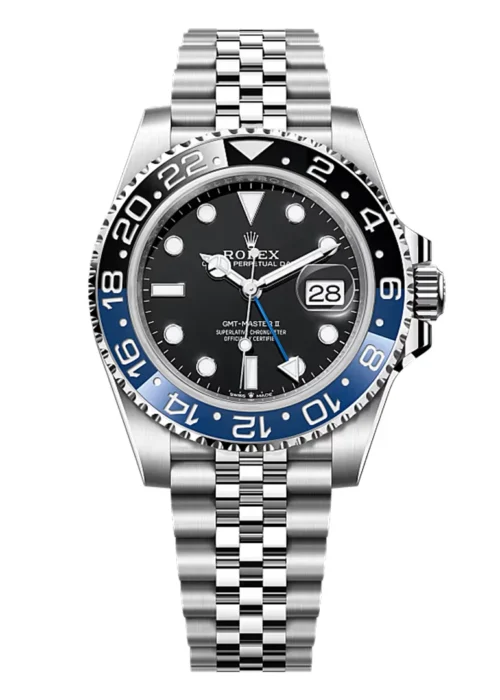
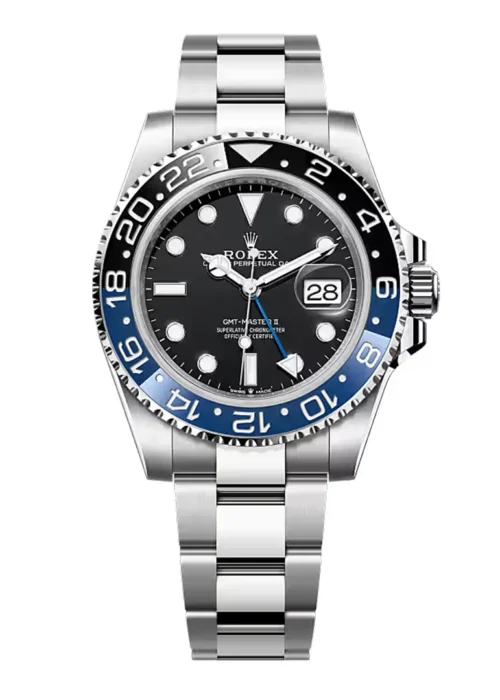
When Rolex unveiled the ref. 126710BLNR at Baselworld 2019, they did more than just update a beloved model — they ignited one of the most passionate debates in modern horology: Jubilee vs Oyster bracelet. Dubbed the “Batgirl” by collectors (a playful nod to the “Batman” BLNR on Oyster), this GMT-Master II redefined what enthusiasts look for in a luxury travel watch. Today, we’re conducting a comprehensive craftsmanship evaluation of the 126710BLNR, exploring its design DNA, movement architecture, and why it has become a benchmark for those exploring the super clone watch category as an accessible luxury alternative.

Specifications & First Impressions
Before diving into aesthetics, let’s ground ourselves in the technical foundation of the 126710BLNR. This is the second-generation BLNR — the first to feature the 3285 Caliber movement and the controversial (yet beloved) Jubilee bracelet as standard.
| Specification | Detail |
|---|---|
| Case Size | 40mm x 11.8mm thickness |
| Case Material | 904L Oystersteel (Superior corrosion resistance) |
| Movement | In-house Caliber 3285 (Chronometer certified) |
| Power Reserve | 70 hours (significant upgrade from 3186’s 48h) |
| Water Resistance | 100m / 330ft |
| Crystal | Scratch-resistant sapphire, Cyclops lens over date |
| Bracelet | Oyster (91200) or Jubilee (91201) — the core debate |
| Bezel Insert | Cerachrom ceramic in blue & black (bicolor) |
| Reference | 126710BLNR (previously 116710BLNR) |
First impressions are immediate: the bicolor Cerachrom bezel remains a visual masterstroke. The deep blue transitioning into near-black creates a duality that shifts under different lighting — sometimes subtle, sometimes dramatic. The Jubilee bracelet, with its five-piece link construction, drapes with a softness that immediately differentiates this from its predecessor.
Design & Aesthetics: A Deep Dive into the Details
The Dial & Hands
The black lacquer dial of the 126710BLNR is pure Rolex restraint at its finest. The Maxi dial architecture features oversized hour markers filled with Chromalight — Rolex’s proprietary luminescent material that emits a striking blue glow rather than traditional green. For discerning collectors, the key detail lies in the handset:
- Mercedes hour hand: Iconic silhouette, polished center, filled with Chromalight
- GMT hand: Triangular tip with blue lacquer fill — perfectly matching the bezel’s blue half
- Date window: Cyclops lens at 3 o’clock, magnifying the date by 2.5x
What elevates this dial beyond mere tool-watch territory is the applied white gold surrounds on each hour marker. These tiny polished frames catch light in a way printed markers never could, adding a layer of visual depth that separates luxury from utility.
Case & Bezel Finishing
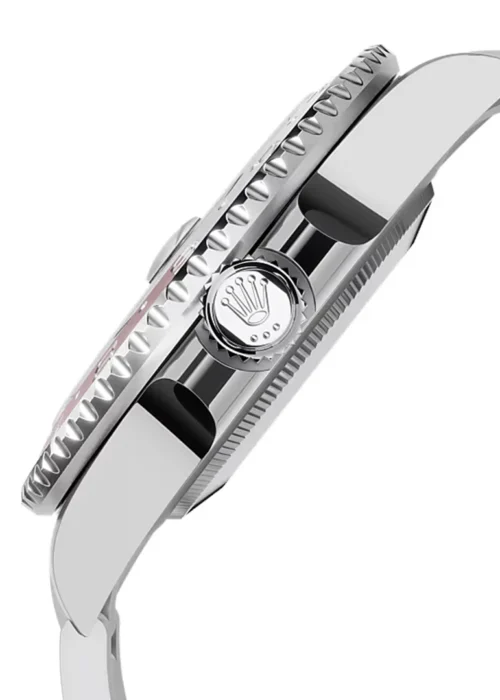
The 40mm Oyster case is a masterclass in contrasting finishes. The top surfaces of the lugs feature a satin-brushed finish, while the chamfered edges on the underside are mirror-polished. This dual-finish approach is extraordinarily difficult to execute in super clone watch manufacturing — most budget-friendly alternatives either miss the sharpness of the chamfer line or fail to maintain the distinction between brushed and polished zones.
The Cerachrom bezel deserves special attention. Unlike aluminum inserts that fade with UV exposure, Rolex’s ceramic formulation is virtually scratch-proof and colorfast. The numerals and graduations are engraved through the ceramic and coated with a microscopically thin layer of 18k gold via PVD (Physical Vapor Deposition). On a high-quality super clone watch, this is one of the first tells — the gold deposition may appear dull or uneven under magnification.

Bracelet & Wearability: The Jubilee vs Oyster Difference
This is the heart of the 126710BLNR conversation. Let’s break down the Rolex 126710BLNR Oyster vs Jubilee bracelet difference in practical terms:
Jubilee Bracelet (91201) — The 2019 standard
- Five-piece link construction: Three polished center links flanked by brushed outer links
- Comfort factor: Drapes like a fine chain — molds to the wrist with zero stiffness
- Visual character: Dressier, more reflective, vintage-coded (references the 1950s Jubilee)
- Oysterlock clasp: Features Easylink 5mm comfort extension
- Best for: Those who want a single watch for boardroom to beach; collectors valuing wrist presence over tool-watch ruggedness
Oyster Bracelet (91200) — The pre-2019 standard, still available on certain references
- Three-piece link construction: Wider, chunkier links with solid end links
- Comfort factor: More rigid — excellent for active wear, less forgiving on smaller wrists
- Visual character: Sportier, more aggressive, tool-watch heritage
- Oysterlock clasp: Same Easylink system, slightly more robust feel
- Best for: Divers, adventurers, purists who believe GMTs should be on Oyster
The Jubilee vs Oyster bracelet difference is not just about looks — it fundamentally changes the wearing experience. The Jubilee transforms the 126710BLNR from a tool watch into a luxury travel companion. It’s the reason the “Batgirl” has become the more desired configuration on the secondary market, often commanding a premium over the Oyster-equipped “Batman.”
Movement & Performance
Beneath the solid caseback lies the Caliber 3285, Rolex’s next-generation GMT movement. This is not merely an evolution of the 3186 — it’s a complete reengineering with 14 patents:
- Chronergy escapement: Nickel-phosphorus construction, 15% more efficient than traditional Swiss lever escapements
- Blue Parachrom hairspring: Magnetic-resistant, shock-absorbing, 10x more precise than standard hairsprings in positional variation
- 70-hour power reserve: Set it down Friday night, pick it up Monday morning — still running
- COSC chronometer + Rolex Superlative: -2/+2 seconds per day after casing (a tighter standard than COSC alone)
For those evaluating a super clone watch, the Caliber 3285 represents the highest bar to clear. Clone movements like the SH3285 (Shanghai) and VR3285 attempt to replicate the functionality — including the correct GMT hand jump and 70-hour reserve — but the finish, regulation, and reliability remain the dividing line between homage and genuine luxury.
Value Proposition: Why the 126710BLNR Matters Today
With retail pricing around $10,700 USD (2024) and secondary market values hovering between $16,000–$20,000 depending on bracelet configuration, the 126710BLNR sits firmly in investment-grade watch territory. But its value extends beyond economics:
- Versatility: The bicolor bezel works with everything from suits to swim trunks
- Legacy: The GMT-Master lineage spans 70 years of aviation history
- Rarity: Production constraints mean waitlists stretch 2–5 years at authorized dealers
This scarcity has driven many collectors to explore the accessible luxury end of the market, where super clone watches offer a way to experience the design language and wearing feel without the decade-long wait or six-figure investment. The key is knowing what to look for — and what compromises to accept.
Pros & Cons: An Objective Assessment
Pros
- ✓ Iconic design: The bicolor bezel is instantly recognizable yet endlessly fascinating
- ✓ Jubilee bracelet: Unmatched comfort for a sports watch; elevates the entire wearing experience
- ✓ Caliber 3285: 70-hour power reserve and -2/+2 accuracy set the standard for GMT movements
- ✓ Resale value: Historically appreciates or holds value better than 95% of luxury watches
- ✓ Dual timezone functionality: True traveler GMT with independent hour hand jumping
Cons
- ✗ Availability: Nearly impossible to buy at retail without extensive AD relationships
- ✗ Premium pricing: Secondary market markups of 50–80% over retail
- ✗ Bracelet debate: If you prefer Oyster, you may feel the Jubilee is too dressy for daily wear
- ✗ No quick-adjust clasp: Easylink offers only 5mm extension — competitors offer tool-free micro-adjust
- ✗ Cyclops polarizing: Some collectors find the magnifier disrupts the dial symmetry
Summary & Final Verdict
Score: 9.3 / 10
The Rolex GMT-Master II 126710BLNR is not a perfect watch — no watch is — but it is arguably the most complete luxury sports watch under $20,000. The Jubilee vs Oyster bracelet difference ultimately comes down to personal style, but the Jubilee’s reintroduction to the GMT line was a masterstroke that broadened the model’s appeal without sacrificing its tool-watch DNA.
Best for:
- Collectors seeking a single high-end travel watch that transitions from formal to casual
- Enthusiasts who value bracelet design as a core part of the wearing experience
- Investors looking for a model with proven historical appreciation
Consider alternatives if:
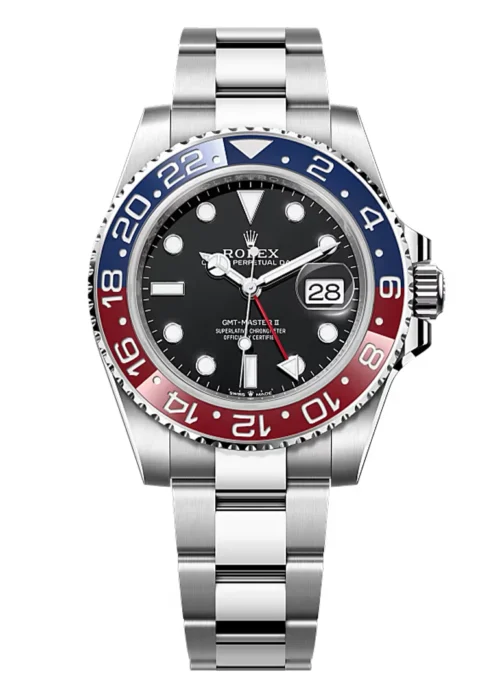
- You prefer a more tool-oriented aesthetic (look at the Oyster-equipped 126710BLRO “Pepsi” or Tudor Black Bay Pro)
- You need a true micro-adjust clasp (consider the Grand Seiko Evolution 9 GMT)
- Budget is a primary concern (explore the super clone watch segment for the design language at accessible luxury pricing)
For those intrigued by the 126710BLNR design philosophy but seeking a more accessible entry point, exploring the craftsmanship found in the super clone watch category offers an illuminating perspective on what separates true luxury from expertly executed homage. The attention to bezel color accuracy, bracelet articulation, and movement finishing in this segment has reached remarkable levels — a testament to how coveted this design truly is.
If you’re ready to explore the finest interpretations of this iconic design, including models that faithfully replicate the Jubilee vs Oyster bracelet difference, visit our curated collection of premium super clone watches to experience the craftsmanship firsthand.