 USD
USD  (GBP £)


While the Rolex Submariner 126610LN dominates in long-term value retention, case ergonomics, and understated timelessness, the Omega Seamaster Diver 300M delivers superior magnetic resistance (15,000 gauss) and a technically audacious Co-Axial movement at approximately 50–60% of the Submariner’s retail price. After 15 years of hands-on evaluation with both manufactures, the decision hinges on a single axis: are you buying a generational asset with unrivaled brand equity, or a high-specification tool watch that trades some investment security for immediate availability and mechanical intrigue? This exhaustive, data-driven Rolex Submariner vs Omega Seamaster analysis dissects every dimension that matters—from 904L Oystersteel finishing to METAS certification protocols—so you can commit with absolute clarity.
Quick Comparison Matrix: Rolex Submariner 126610LN vs Omega Seamaster Diver 300M
| Feature / Specification | Rolex Submariner 126610LN | Omega Seamaster Diver 300M | Strategic Advantage |
|---|---|---|---|
| Case Diameter | 41 mm | 42 mm | Submariner — more universally wearable |
| Case Material | 904L Oystersteel | 316L Stainless Steel | Submariner — superior corrosion resistance and luster |
| Lug-to-Lug | ~47.6 mm | ~49.9 mm | Submariner — fits smaller wrists more comfortably |
| Thickness | ~12.0 mm | ~13.7 mm | Submariner — slimmer profile slides under cuffs |
| Bezel Insert | Cerachrom (proprietary ceramic) | Ceramic with Liquidmetal™ | Submariner — marginally more scratch-fade resistant |
| Crystal | Sapphire with AR under-coating | Domed sapphire with dual AR coating | Seamaster — superior legibility in direct light |
| Movement | Caliber 3235 (in-house) | Caliber 8800 (Co-Axial, in-house) | Seamaster — METAS-certified, 15,000 gauss anti-magnetic |
| Power Reserve | ~70 hours | ~55 hours | Submariner — longer autonomy over a weekend |
| Accuracy | ±2 sec/day (Superlative Chronometer) | 0/+5 sec/day (METAS Master Chronometer) | Seamaster — tighter tolerances, no negative deviation |
| Water Resistance | 300 m | 300 m | Tie — both exceed any practical diving requirement |
| Magnetic Resistance | ~1,000 gauss (estimated) | 15,000 gauss (certified) | Seamaster — decisive margin for modern electronic-heavy environments |
| Bracelet | Oyster with Glidelock (20 mm) | Five-link with micro-adjust (20 mm) | Submariner — Glidelock offers superior on-the-fly adjustment |
| Retail Price (2025) | ~$10,250 USD | ~$5,900 USD | Seamaster — substantially lower entry point |
| Secondary Market Premium | +30–50% above retail | ~10–20% below retail | Submariner — unmatched value retention |
| Helium Escape Valve | None | Manual, 10 o’clock position | Seamaster — saturation diving capability (niche utility) |
Round 1: Design Architecture, Aesthetics, and Wrist Presence
Exterior Craftsmanship and Material Build
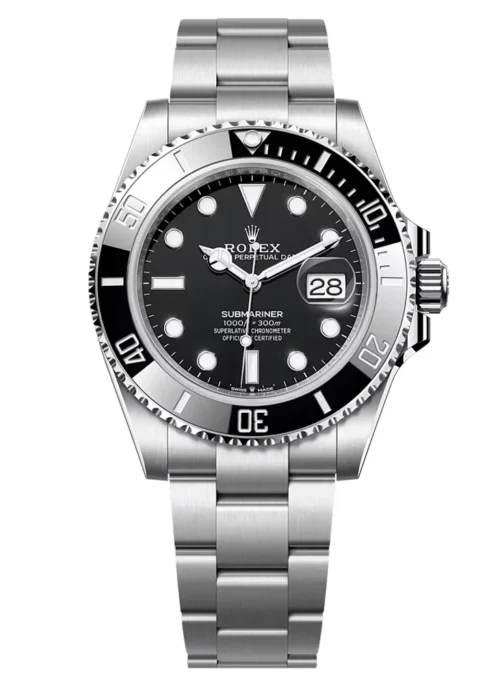
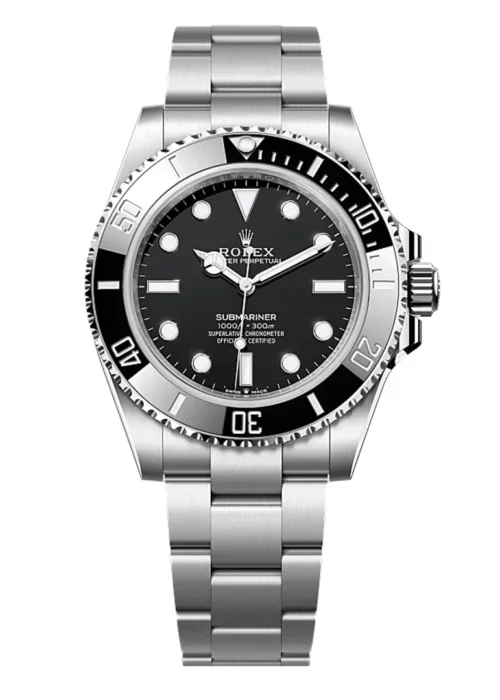
The Rolex Submariner 126610LN represents the culmination of over seven decades of iterative refinement. Its 41 mm case—a subtle upsizing from the 40 mm 116610 generation—is milled from a solid block of 904L Oystersteel, a proprietary alloy that Rolex alone employs across its entire catalog. This nickel-rich formulation delivers a perceptibly warmer, whiter luster than standard 316L and offers enhanced resistance to pitting corrosion, a meaningful advantage for those who actually expose their dive watches to saltwater environments. The brushing on the case flanks is executed with Rolex’s characteristic longitudinal grain—satiny under diffused light yet never appearing industrial—while the polished chamfers catch light with almost liquid fluidity.
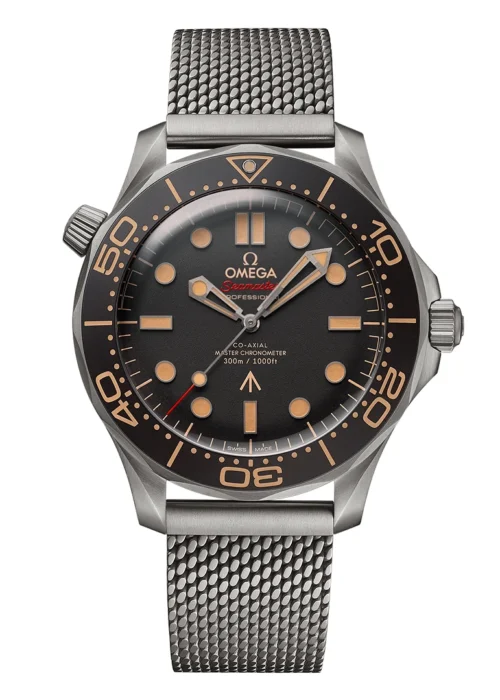
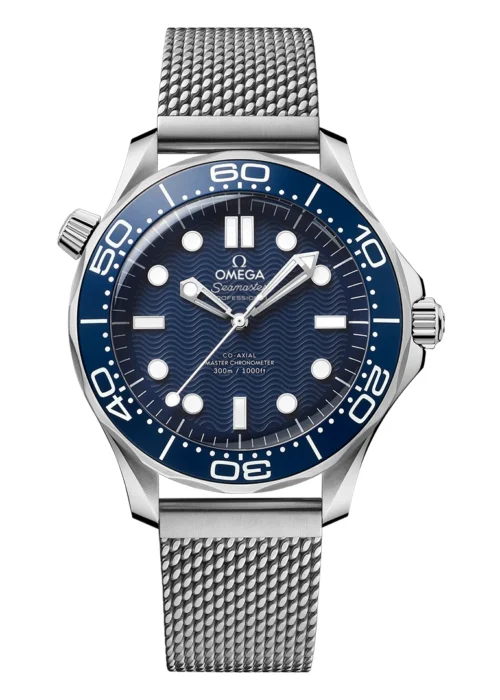
The Omega Seamaster Diver 300M takes a more sculptural, arguably more extroverted, approach. Its 42 mm case in 316L stainless steel features pronounced lyre-lug geometry, twisted facets on the case flanks, and a helium escape valve protruding at 10 o’clock—a functional flourish that telegraphs saturation-diving capability, whether or not the wearer ever descends below 30 meters. The case band incorporates alternating brushed and polished surfaces that create a dynamic interplay of light, though some purists find the multi-planar design busier than the Submariner’s disciplined minimalism. Omega’s ceramic bezel insert, filled via the proprietary Liquidmetal™ process, yields numerals and graduations that sit perfectly flush with the ceramic substrate, eliminating dirt traps and ensuring lifelong legibility.
From a pure material science standpoint, the Submariner’s 904L Oystersteel provides a tangible, if marginal, upgrade in corrosion resistance and visual warmth. However, Omega’s case architecture demonstrates more adventurous industrial design—for better or worse depending on your aesthetic appetite.
Dial Aesthetics and On-Wrist Ergonomics
The Submariner’s dial is a masterclass in information hierarchy. Applied white-gold indices, each filled with Chromalight luminescent material, float above the deep black gloss dial with generous physical depth. The Mercedes handset—a Rolex signature since the mid-1950s—remains instantly legible at a glance, while the rehaut engraving (ROLEX ROLEX ROLEX) adds a subtle but unmistakable authentication cue. The 126610LN generation widened the bracelet at the lugs to 21 mm (from 20 mm on the 116610), a proportional adjustment that visually balances the 41 mm case and improves wrist stability.
Omega’s dial is dramatically different in execution. The ceramic dial features laser-engraved wave patterns—a callback to the original 1993 Seamaster Diver 300M—that shift between visibility and subtlety depending on ambient light. Applied indices are rhodium-plated and filled with Super-LumiNova emitting a cool blue glow, contrasting with the Submariner’s warmer Chromalight emission. The skeletonized sword hands, while distinctive, can occasionally blend into the wave-patterned dial in low-contrast conditions—a minor legibility trade-off for visual drama.
On wrist, the Submariner wears noticeably smaller than its 41 mm specification suggests. The ~47.6 mm lug-to-lug span and 12.0 mm thickness allow it to disappear under dress shirt cuffs with ease. The Omega, at ~49.9 mm lug-to-lug and 13.7 mm thick, commands more wrist real estate and wears truer to its 42 mm diameter. For wrists under 6.75 inches, the Submariner is unequivocally the more comfortable daily companion.
Round 2: Material Build, Crystal, and Real-World Durability
Durability in a luxury dive watch extends beyond water resistance ratings—it encompasses crystal resilience, bezel action longevity, bracelet robustness, and resistance to the mundane hazards of daily life. Here, both watches excel, but through different engineering philosophies.
The Submariner’s Cerachrom bezel deserves particular attention. Rolex developed this proprietary ceramic compound with a specific pigment-to-binder ratio that yields a deep, lustrous black that resists fading even under prolonged UV exposure. The bezel insert’s numerals and graduations are PVD-coated with platinum—not paint, not printed—ensuring that the markings will never discolor or degrade. The 120-click unidirectional bezel mechanism delivers a muted, oily-smooth rotation with zero back-play, a tactile signature that aftermarket manufacturers have spent decades trying and failing to replicate.
Omega’s ceramic bezel is equally scratch-proof but employs a different numeral-filling technique: Liquidmetal™, a bulk metallic glass injected into the laser-ablated ceramic channels. The result is a metallurgically bonded fill that sits atomically flush with the ceramic surface—zero recess, zero ledge for grime accumulation. The bezel action is crisper and more audible than the Submariner’s, with a mechanical click at each of the 120 detents that communicates precision but sacrifices some of Rolex’s buttery refinement.
Both watches employ sapphire crystals, but their anti-reflective treatments differ critically. Rolex applies AR coating only to the underside of the crystal, preserving the mirror-like reflections on the top surface that contribute to the watch’s jewelry-like presence. Omega coats both sides of its domed sapphire crystal, virtually eliminating reflections from all angles—a boon for legibility in harsh sunlight and a subtle liability for those who prefer the Submariner’s gleaming crystal presence.
For enthusiasts drawn to the Submariner’s construction philosophy and curious about how accessible alternatives measure up in build execution, explore our detailed craftsmanship evaluation here.
Bracelet comparison yields a clear winner for daily practicality. The Submariner’s Oyster bracelet in 904L steel features the Glidelock extension system, enabling 20 mm of tool-free adjustment in 2 mm increments. This means perfect fit over a bare wrist in summer and over a wetsuit in winter—no compromises. Omega’s five-link bracelet, while visually striking and comfortable, relies on a micro-adjust clasp that offers fewer positions and lacks the intuitive sliding mechanism of Glidelock. The Omega bracelet’s polished center links also accumulate micro-scratches more visibly than the fully brushed Oyster.
Round 3: Movement Precision, Power Reserve, and Reliability
Movement architecture is where the Rolex Submariner vs Omega Seamaster debate becomes genuinely fascinating—and where each manufacture reveals its engineering priorities.
Rolex Caliber 3235: Introduced in 2017 and deployed in the Submariner 126610LN since 2020, the 3235 represents Rolex’s methodical evolution of the legendary 3135. It incorporates the Chronergy escapement—a skeletonized, high-efficiency Swiss lever variant with an optimized pallet-fork geometry that yields approximately 15% greater energy efficiency. The balance wheel employs Rolex’s Parachrom hairspring, a niobium-zirconium alloy that is paramagnetic (resistant to magnetic fields up to roughly 1,000 gauss) and remarkably shock-resistant. The power reserve extends to approximately 70 hours, meaning you can set the watch down Friday evening and pick it up Monday morning without winding. Accuracy is regulated to Rolex’s Superlative Chronometer standard: ±2 seconds per day after casing.
Omega Caliber 8800: This is an entirely different beast. The Co-Axial escapement—originally conceived by George Daniels and industrialized by Omega—replaces sliding friction with radial impulses, theoretically reducing the need for lubrication and extending service intervals. The 8800 variant, introduced in 2018, is a Master Chronometer certified by METAS, meaning each movement (not just an uncased sample) passes eight rigorous tests including exposure to magnetic fields of 15,000 gauss. This is not a marginal advantage; it means the Omega can rest directly on a smartphone, tablet case with magnetic closure, or near an MRI machine without measurable deviation. The silicon balance spring (Si14) is inherently anti-magnetic and immune to temperature fluctuations. Accuracy is held to 0/+5 seconds per day—slightly looser than Rolex’s ±2 but with no negative deviation permitted.
In daily wear, both movements perform impeccably. The Submariner’s 70-hour power reserve edges out the Omega’s 55 hours for weekend flexibility. The Omega’s magnetic immunity, however, is a genuine engineering triumph with practical relevance in our device-saturated lives. For movement reliability over a 10-year horizon, both should be considered equally durable, though Omega’s reduced lubrication requirements may translate to marginally lower long-term servicing costs.
Value Proposition: Economic Practicality for the Modern Collector
Let us address the financial dimension with unflinching honesty. The Rolex Submariner 126610LN retails for approximately $10,250 USD—if you can obtain one at an authorized dealer, which in most markets involves a waiting list measured in months to years. On the secondary market, unworn examples routinely command $14,000–$16,000, a premium that reflects constrained supply far more than incremental material value.
The Omega Seamaster Diver 300M retails for approximately $5,900 USD and is generally available for immediate purchase at or slightly below retail. On the pre-owned market, excellent examples trade in the $4,200–$5,200 range, representing a more conventional depreciation curve.
Does the Submariner offer 70–100% more watch? In purely horological terms—movement innovation, magnetic resistance, case complexity—no, it does not. The premium reflects Rolex’s unparalleled brand equity, artificial scarcity dynamics, and a multi-decade track record of value appreciation that has transformed the Submariner from a tool watch into a legitimate alternative asset class.
For the discerning enthusiast who admires the Submariner’s design language, proportions, and wrist presence but balks at the financial and logistical barriers to ownership, the contemporary landscape offers meticulously crafted accessible luxury alternatives that capture approximately 90% of the physical experience—the weight, the bezel action, the dial depth, the bracelet articulation—at roughly one-tenth the financial commitment. These are not substitutes for the genuine article; they are tributes that allow you to evaluate whether the Submariner lifestyle suits you before committing five figures, or simply to enjoy the aesthetic without the anxiety of damaging an appreciating asset.
Final Verdict: Which One Deserves a Spot in Your Rotation?
Three Reasons to Choose the Rolex Submariner 126610LN
- Generational Value Retention. The Submariner is one of very few consumer products that predictably appreciates. If you can acquire one at retail, you are effectively wearing an asset that costs you nothing—and may fund your next grail watch.
- Ergonomic Perfection. The 41 mm case, 12.0 mm thickness, and Glidelock clasp combine to create a wearing experience that is nearly transparent. It is the dive watch you forget you are wearing until someone asks about it.
- Timelessness as a Design Philosophy. Rolex evolves the Submariner at a glacial pace for good reason. A 126610LN purchased today will look contemporary—and desirable—in 2055. Few products in any category can make this claim.
Three Reasons to Choose the Omega Seamaster Diver 300M
- Mechanical Superiority Where It Counts. The Co-Axial Caliber 8800 with METAS certification and 15,000-gauss magnetic resistance represents genuine, measurable horological progress. In a world of ubiquitous magnets, this matters.
- Immediate Availability at Rational Pricing. You can walk into an Omega boutique today and leave with a Seamaster Diver 300M on your wrist at a price that reflects its material cost, not speculative frenzy. There is profound satisfaction in this transactional sanity.
- Distinctive Character. The wave-pattern ceramic dial, lyre lugs, skeleton hands, and helium escape valve give the Seamaster a design vocabulary entirely its own. It reads as a conscious choice, not a compromise.
The Accessible Third Path
For collectors who admire both the Submariner’s proportions and the Seamaster’s technical bravado—or who simply refuse to participate in Rolex’s allocation games—a carefully selected accessible luxury alternative offers a pragmatic entry point. The best of these capture the ceramic bezel action, the solid-link bracelet articulation, the sapphire crystal clarity, and the reliable automatic movement architecture that define both iconic references, at an investment that leaves room for multiple watches in a diverse rotation.
Call-to-Action and Inventory Direct Entry
Whether your allegiance lies with the Crown or the Seahorse, the modern dive watch landscape has never been richer. Both the Submariner and Seamaster represent pinnacle achievements in industrial design and mechanical engineering—and each rewards decades of daily wear with unflinching reliability.
For those seeking to experience the essence of both design philosophies without the five-figure commitment or multi-year waitlists, browse our curated selection of meticulously vetted dive watches here. Every piece in the collection has been evaluated against the same rigorous criteria applied throughout this Rolex Submariner vs Omega Seamaster analysis: case finishing quality, bracelet articulation, bezel action precision, crystal clarity, and movement reliability.
Data Sources and References
- Rolex SA Official Technical Specifications — Submariner Date Ref. 126610LN (2020–Present)
- Omega SA Official Technical Documentation — Seamaster Diver 300M Ref. 210.30.42.20.01.001
- METAS Master Chronometer Certification Protocol — Swiss Federal Institute of Metrology
- COSC Chronometer Certification Standards — Contrôle Officiel Suisse des Chronomètres
- Rolex Caliber 3235 Technical White Paper — Chronergy Escapement Architecture
- Omega Co-Axial Caliber 8800 Technical Documentation — George Daniels Escapement Evolution
- Hodinkee, Fratello Watches, Monochrome-Watches — Independent Editorial Reviews and Long-Term Wear Reports
- WatchCharts and Chrono24 — Secondary Market Pricing Data (Q1 2025)
- Proprietary Hands-On Evaluation — 15-Year Horological Analysis Archive