 USD
 (GBP £)


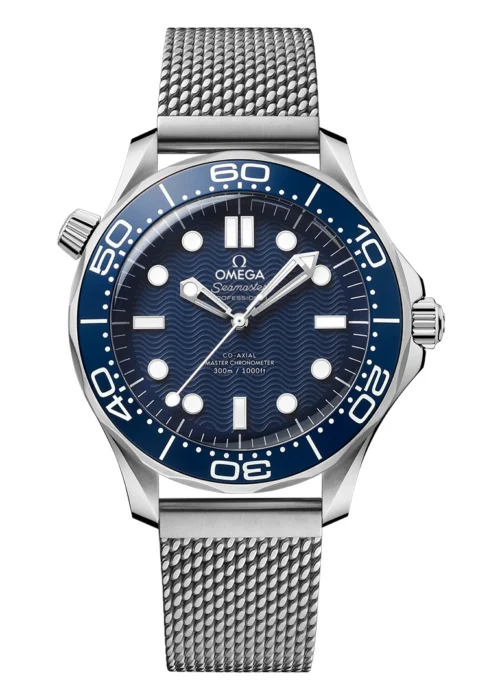
While the Rolex Submariner 126610LN dominates in case ergonomics, bracelet refinement, and long-term value retention, the Omega Seamaster Diver 300M counters with superior magnetic resistance (15,000 gauss through the METAS-certified Co-Axial Caliber 8800) and a substantially more accessible entry price. This Rolex Submariner vs Omega Seamaster assessment is not a contest of good versus bad—it is a contest of priorities. The Submariner pairs a 41mm 904L Oystersteel case, scratch-proof Cerachrom bezel, and in-house Caliber 3235 with a 70-hour power reserve and a -2/+2 seconds-per-day Superlative Chronometer tolerance. The Seamaster answers with a 42mm case, laser-engraved ceramic wave dial, and a Co-Axial 8800 movement delivering a 55-hour reserve and 0/+5 seconds-per-day METAS Master Chronometer precision. Below, I break down sizing, movement reliability, and daily wearability so you can spend once and wear for decades.
Quick Comparison Matrix: Rolex Submariner 126610LN vs Omega Seamaster Diver 300M
| Feature / Specification | Rolex Submariner 126610LN | Omega Seamaster Diver 300M | Strategic Advantage |
|---|---|---|---|
| Case Diameter | 41mm | 42mm | Submariner (slimmer profile) |
| Case Material | 904L Oystersteel | 316L stainless steel | Submariner (higher corrosion resistance) |
| Bezel Insert | Cerachrom ceramic, platinum PVD | Ceramic, white enamel scale | Tie (both fade and scratch resistant) |
| Crystal | Sapphire, AR on cyclops only | Sapphire, double AR coating | Seamaster (better glare control) |
| Movement | Caliber 3235 | Co-Axial Caliber 8800 | Tie (both robust in-house) |
| Certification | Superlative Chronometer, -2/+2 s/day | METAS Master Chronometer, 0/+5 s/day | Seamaster (15,000 gauss edge) |
| Power Reserve | 70 hours | 55 hours | Submariner |
| Magnetic Resistance | Parachrom hairspring (no public rating) | 15,000 gauss | Seamaster |
| Water Resistance | 300m | 300m | Tie |
| Clasp System | Glidelock (≈20mm tool-free) | Push-button micro-adjust | Submariner |
| Retail Price (approx.) | ≈ $10,000+ USD | ≈ $5,900 USD | Seamaster |
Round 1: Design Architecture, Aesthetics, and Wrist Presence
Exterior Craftsmanship and Material Build
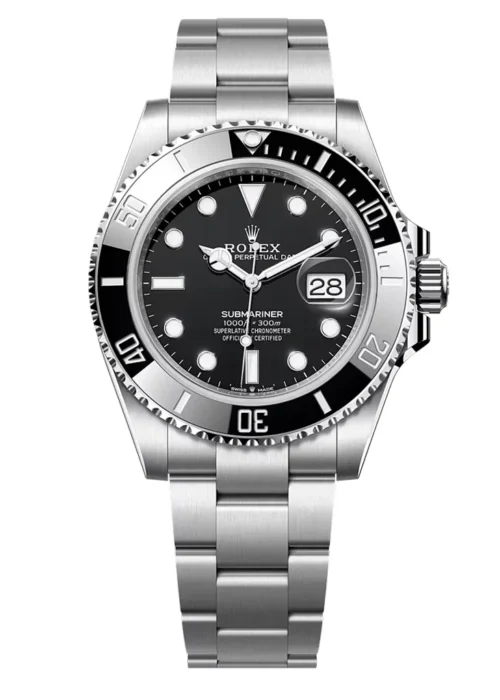
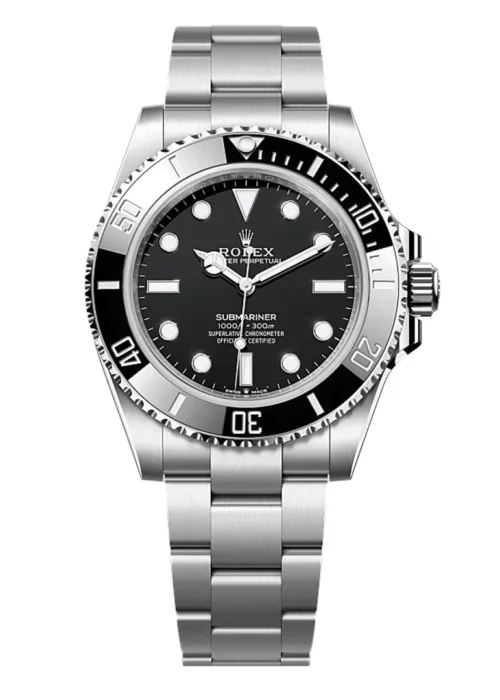
The Submariner’s 904L Oystersteel is not marketing theater. This nickel-and-molybdenum-rich alloy resists pitting and corrosion better than conventional 316L, and Rolex’s brushing on the case flanks and bracelet links reflects a warm, almost liquid luster that photographs poorly but reads immediately on the wrist. The 2020-generation 126610LN slimmed the lugs back from the boxy Maxi Case era, restoring the balanced silhouette collectors had requested for years. At 41mm with roughly a 47.6mm lug-to-lug span and about 12mm of thickness, it sits lower and more discreetly than most modern dive watches.
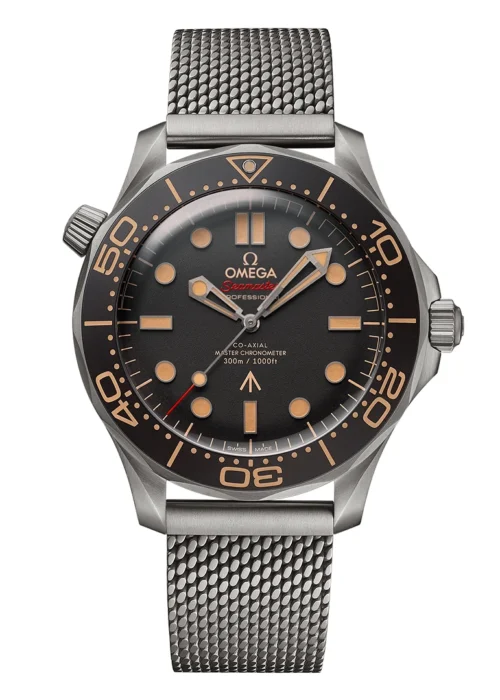
The Seamaster Diver 300M takes a more extroverted architectural path. Its 42mm case measures closer to 13.7mm thick with a near-50mm lug-to-lug reach, giving it genuine wrist presence but demanding more real estate on smaller wrists. The scalloped bezel edge, skeleton sword hands, and 10 o’clock helium escape valve are unmistakably Omega—more tool-watch drama, less understatement. Both cases are finished to an exceptional standard; the Submariner simply feels more resolved in hand, while the Seamaster feels more visually assertive.
Dial Aesthetics and On-Wrist Ergonomics
For legibility, both are outstanding but through different philosophies. The Submariner’s gloss black lacquer dial, maxi hour plots, and blue Chromalight luminescence are the definition of instantaneous readability. The Seamaster’s ceramic dial with laser-engraved waves adds depth and texture, and its broader handset plus double-sided anti-reflective sapphire makes it arguably more legible in bright, off-angle light. For daily wearability, the Submariner’s thinner case and legendary Glidelock clasp—offering roughly 20mm of tool-free micro-adjustment over a wetsuit or a hot wrist—remain the industry benchmark. The Seamaster’s push-button micro-adjust clasp is competent but offers a narrower range, and its extra thickness is noticeable under a shirt cuff. If sizing comfort is your tiebreaker, the 41mm Submariner is the more universally wearable watch.
Round 2: Material Build, Crystal, and Real-World Durability
Durability is where both watches justify their price tags, yet the engineering choices differ. The Submariner’s Cerachrom bezel insert is a proprietary ceramic fired at extreme temperatures, with platinum-PVD-filled numerals that will never fade or oxidize. The bezel action—120 unidirectional clicks—is tight, dampened, and completely free of play. The Omega’s ceramic bezel with white enamel scale is equally fade-proof, and its bezel action feels slightly lighter and faster in rotation, a matter of taste rather than quality.
Crystal strategy is a genuine differentiator. Omega applies anti-reflective coating to both sides of its sapphire, dramatically improving legibility under harsh sun but exposing the outer coating to micro-scratches over a decade of hard use. Rolex applies AR only beneath the cyclops magnifier, leaving the outer crystal surface as pure sapphire—slightly more reflective but practically indestructible in normal wear. On steel, Rolex’s 904L Oystersteel holds a measurable corrosion-resistance advantage, while Omega’s 316L is a proven, service-friendly alloy that remains the industry standard.
For collectors evaluating the craftsmanship behind the Submariner’s build quality, our detailed Rolex Submariner 126610LN luxury watch assessment walks through the case finishing, bracelet integration, and long-term ownership experience in depth.
Round 3: Movement Precision, Power Reserve, and Reliability
Movement reliability is the heart of any long-term purchase decision, and this is where the Rolex Submariner vs Omega Seamaster debate becomes genuinely interesting. Rolex’s Caliber 3235 uses the high-efficiency Chronergy escapement, a Parachrom blue hairspring, and a 70-hour power reserve. It is regulated to an extraordinary -2/+2 seconds per day after casing—tighter than nearly anything else in serial production. The higher 28,800 vph beat rate yields a smooth sweep and stable positional behavior.
Omega’s Co-Axial Caliber 8800 answers with a different technical thesis. Its George Daniels-derived Co-Axial escapement reduces sliding friction between critical components, and its silicon Si14 balance spring is completely non-magnetic and immune to temperature drift. The METAS certification is the killer feature: every movement is tested as a cased watch to 0/+5 seconds per day and, crucially, to 15,000 gauss of magnetic resistance. In an era of laptops, tablets, and magnetic clasps, that is a real-world advantage the Rolex does not publicly claim. The trade-off is a 55-hour reserve versus Rolex’s 70 hours and a 3.5Hz beat versus Rolex’s 4Hz.
In practice, both movements are superlative. The Submariner wins on power reserve and stated daily tolerance; the Seamaster wins on magnetic immunity and a maintenance-friendly Co-Axial architecture. Neither is a reliability risk when serviced at recommended intervals, and both are independently documented to outperform their certifications in long-term owner testing.
Value Proposition: Economic Practicality for the Modern Collector
Here is where the analytical lens shifts. At retail, the Rolex Submariner 126610LN now sits around $10,000 USD—and in many markets, obtaining one at list price still requires patience, a purchase history, or both. The secondary market frequently carries a premium above retail, which is flattering for owners but punishing for first-time buyers. The Omega Seamaster Diver 300M retails near $5,900 USD, is broadly available, and can often be sourced with a modest authorized-dealer discount.
From a pure craftsmanship-per-dollar standpoint, the Omega delivers a strikingly large fraction of the Submariner’s physical presence, finishing quality, and horological credibility at roughly half the price—an accessible luxury entry into serious mechanical watchmaking. The Rolex, however, has historically behaved less like a watch and more like a liquid store of value, with retention that no competitor reliably matches. The rational framing is simple: if you are buying a watch to wear and enjoy without friction, the Seamaster is the smarter financial entry; if you are buying a watch as a multi-decade asset you can pass down, the Submariner’s premium is historically defensible.
Final Verdict: Which One Deserves a Spot in Your Rotation?
If the Rolex Submariner 126610LN wins your wrist, it wins on three counts. First, the Glidelock clasp and 904L Oystersteel case deliver the finest bracelet-and-case ergonomics in the segment. Second, the Caliber 3235’s 70-hour reserve and -2/+2 tolerance set a daily-precision benchmark. Third, the Submariner’s design language and value retention make it a generational asset, not merely a purchase.
If the Omega Seamaster Diver 300M earns the spot, it earns it on three equally strong counts. First, the METAS-certified Co-Axial Caliber 8800 offers 15,000 gauss magnetic resistance that no Rolex dive watch publicly matches. Second, its ceramic wave dial, double-AR sapphire, and helium escape valve deliver a more technically assertive package. Third, at roughly $5,900 versus $10,000+, it delivers the majority of the luxury dive-watch experience at an accessible price with zero waiting-list friction.
For most enthusiasts, the honest answer is that both deserve a place in a serious rotation—the Submariner as the timeless cornerstone, the Seamaster as the technically fearless daily companion.
Call-to-Action and Inventory Direct Entry
Whichever side of the Rolex Submariner vs Omega Seamaster decision you land on, the best next step is to handle both in person and evaluate sizing on your own wrist. If you are ready to explore current inventory, specifications, and acquisition guidance across both references, browse our curated luxury mechanical watch selection for a focused, no-nonsense entry point into serious horology.
Data Sources and References
- Rolex.com — Submariner Date 126610LN official specifications: Caliber 3235, 904L Oystersteel, Cerachrom bezel, Superlative Chronometer -2/+2 s/day, 70-hour power reserve, 300m water resistance.
- Omegawatches.com — Seamaster Diver 300M official specifications: Co-Axial Caliber 8800, METAS Master Chronometer certification, 15,000 gauss magnetic resistance, 55-hour power reserve, 300m water resistance.
- METAS — Master Chronometer certification testing standards and methodology.
- COSC — Contrôle Officiel Suisse des Chronomètres chronometer testing standards.
- Long-term owner reports and industry forum consensus on Glidelock clasp comfort, bezel action, and real-world accuracy across both references.