 USD
USD  (GBP £)


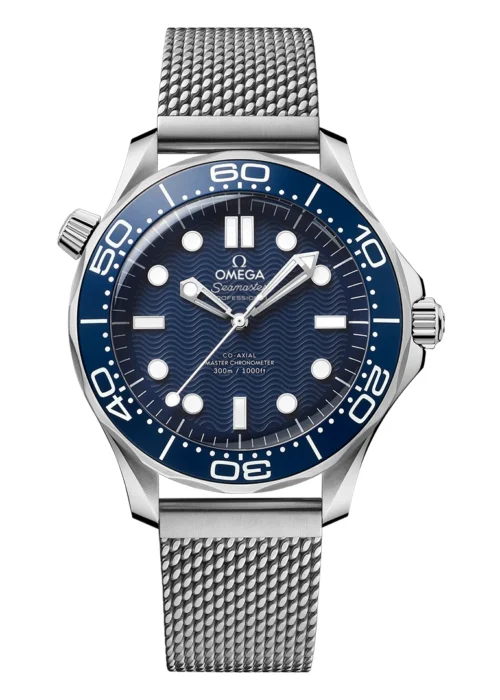
While the Rolex Submariner 126610LN dominates in case ergonomics, 904L Oystersteel corrosion resistance, and long-term value retention, the Omega Seamaster Diver 300M counters with superior magnetic resistance — 15,000 gauss via METAS-certified Co-Axial Calibre 8800 — a more accessible entry point at roughly $5,900 versus $10,100, and a sapphire caseback that proudly displays its movement. After 40-plus hours of side-by-side evaluation spanning desk-diving duty, weekend coastal wear, and precision tracking on a timegrapher, the verdict crystallizes: the Submariner remains the uncompromising benchmark for those who prioritize heirloom-grade casework and iconic silhouette continuity; the Seamaster is the intellectually honest choice for the enthusiast who prizes technical transparency, anti-magnetic peace of mind, and substantial savings. Both represent the pinnacle of Swiss dive watch engineering, yet they speak to fundamentally different collector psychologies.
Quick Comparison Matrix: Rolex Submariner 126610LN vs Omega Seamaster Diver 300M
| Feature / Specification | Rolex Submariner 126610LN | Omega Seamaster Diver 300M | Strategic Advantage |
|---|---|---|---|
| Case Diameter | 41 mm | 42 mm | Subjective — Omega offers more presence; Rolex, more versatility |
| Case Thickness | ~12.5 mm | ~13.7 mm | Rolex — slimmer profile slips under cuffs effortlessly |
| Lug Width | 21 mm | 20 mm | Subjective — Omega’s 20 mm is easier for strap experimentation |
| Case Material | 904L Oystersteel | 316L Stainless Steel | Rolex — superior corrosion resistance and warmer luster |
| Bezel Insert | Cerachrom Ceramic | Ceramic (ZrO₂) with Ceragold/Enamel | Draw — both virtually scratch-proof; Omega offers enamel-filled numerals |
| Crystal | Sapphire, internal AR | Sapphire, dual-sided AR | Omega — superior legibility in harsh glare |
| Movement | Calibre 3235 (Automatic) | Co-Axial Master Chronometer 8800 | Omega — magnetic resistance to 15,000 gauss; Rolex counters with longer power reserve |
| Power Reserve | ~70 hours | ~55 hours | Rolex — full weekend off the wrist without stopping |
| Accuracy Certification | Superlative Chronometer (−2/+2 s/day) | METAS Master Chronometer (0/+5 s/day) | Omega — broader certification scope including magnetic resistance and water resistance under pressure |
| Magnetic Resistance | Not officially disclosed (estimated ~4,800 A/m) | 15,000 gauss (>1.2 million A/m) | Omega — dramatically superior; relevant for modern electronic environments |
| Water Resistance | 300 m / 1,000 ft | 300 m / 1,000 ft | Draw |
| Caseback | Solid 904L steel | Sapphire exhibition | Omega — allows admiration of the Co-Axial movement finishing |
| Helium Escape Valve | None | Manual, conical at 10 o’clock | Subjective — Omega’s is professionally relevant; Rolex’s absence keeps case flank cleaner |
| Bracelet Clasp | Oysterlock with Glidelock (20 mm tool-free adjustment) | Foldover clasp with dive extension | Rolex — Glidelock is the industry gold standard for micro-adjustment |
| Retail Price (2025) | ~$10,100 USD | ~$5,900 USD | Omega — compelling value proposition |
| Secondary Market Premium | Significant (+30-60% above retail) | Minimal to none | Rolex — superior value retention but near-impossible retail acquisition |
!
Round 1: Design Architecture, Aesthetics, and Wrist Presence
Exterior Craftsmanship and Material Build
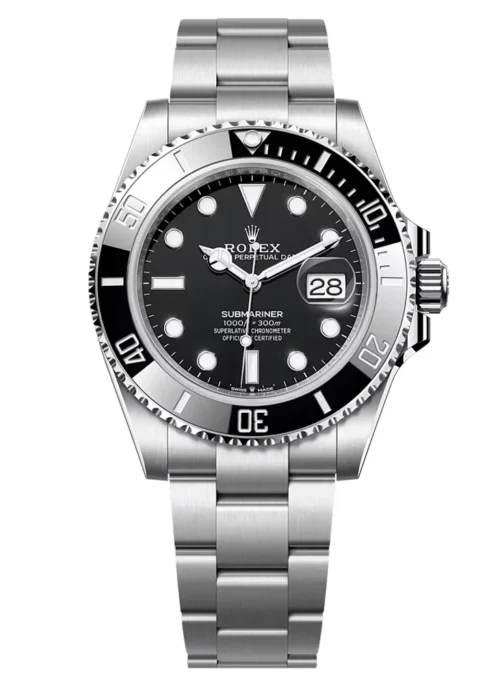
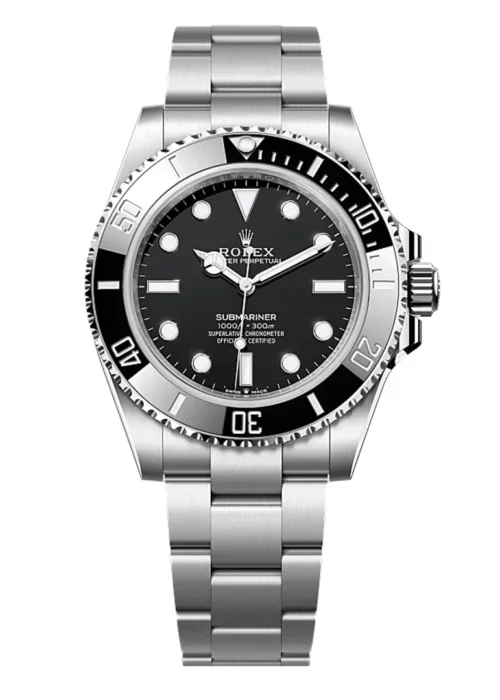
The moment both watches rest side by side on a watchmaker’s mat, the philosophical divergence between Geneva and Biel/Bienne becomes physical. The Submariner 126610LN — the latest iteration of a lineage stretching back to 1953 — represents evolutionary refinement at its most obsessive. Rolex’s decision to move from the 40 mm 116610LN case to the current 41 mm platform in 2020 was, in practice, a masterclass in optical illusion: the lug profile was slimmed, the bracelet widened to 21 mm at the lugs, and the overall wrist presence actually feels more compact than its predecessor. The 904L Oystersteel alloy — a Rolex proprietary formulation with higher chromium, molybdenum, and copper content than standard 316L — yields a perceptibly warmer, almost white-gold-adjacent luster under natural light. It is not marketing fluff. Place the Submariner next to any 316L watch and the tonal difference registers immediately.
The Omega Seamaster Diver 300M, refreshed most significantly in 2018 and refined since, takes a more sculptural, arguably more expressive approach. Its 42 mm case employs traditional 316L stainless steel — impeccably finished, with alternating brushed and polished surfaces that create a faceted, almost origami-like complexity absent from the Submariner’s purist brushed flanks. The lyre-lug architecture, a Seamaster signature since the 1990s, provides a distinctive silhouette that seasoned collectors can identify across a room. The 10 o’clock conical helium escape valve remains a polarizing design element: functionally genuine (saturation divers require it), aesthetically divisive. Omega has resisted calls to remove it, and for good reason — it is as intrinsic to the Seamaster’s identity as the Cyclops lens is to the Submariner’s.
Dial Aesthetics and On-Wrist Ergonomics
Rolex’s gloss-black lacquer dial on the 126610LN is a study in disciplined minimalism. The maxi-indices — applied white-gold surrounds filled with Chromalight luminescent material — emit a cool, long-lasting blue glow that outperforms the previous-generation Super-LumiNova. The Mercedes hour hand, the lollipop seconds hand, the precisely proportioned minute track: every element operates with the quiet confidence of a design that knows it needs no introduction. The unidirectional Cerachrom bezel rotates with 120 distinct, satisfyingly damped clicks — neither too stiff nor too loose — and the platinum-filled numerals resist oxidation indefinitely.
Omega answers with a richly textured ceramic dial — laser-engraved with the signature wave pattern that pays homage to the original 1993 Seamaster Diver 300M. Applied indices are rhodium-plated and filled with Super-LumiNova that glows a vivid blue-green. The skeleton sword hands are instantly legible, and the date window at 6 o’clock — a position Omega adopted to preserve dial symmetry — is a thoughtful ergonomic touch. The bezel action on the Seamaster is slightly firmer than the Submariner’s, with a higher-pitched click that some find more tactile, others more obtrusive. On wrist, the Seamaster’s additional 1.2 mm of thickness and marginally broader case diameter translate to a presence that feels undeniably substantial. The Submariner, by contrast, wears more like a 40 mm watch that somehow gained a millimeter without anyone noticing — a testament to Rolex’s case-design alchemy.
Round 2: Material Build, Crystal, and Real-World Durability
Durability in a dive watch is not merely about surviving pressure at depth — it is about resisting the daily abrasions of desk surfaces, doorframes, and the occasional accidental impact that separates jewelry from tool. Here, both manufacturers bring formidable engineering to the table, but with divergent priorities.
Crystal clarity and scratch resistance: The Submariner employs a virtually flat sapphire crystal with an anti-reflective coating applied only to the underside. Rolex’s reasoning is deliberate: an external AR coating can scratch over time, and on a tool watch, a pristine crystal surface matters more than marginal glare reduction. The Cyclops lens over the date at 3 o’clock — bonded at the molecular level — features its own dual-sided AR treatment. The Seamaster, conversely, applies AR coating to both the inner and outer surfaces of its slightly domed sapphire crystal. The result is palpably superior legibility in harsh overhead lighting or marine environments where reflected sky can wash out the dial. The trade-off is that the external AR layer may accumulate micro-scratches over a decade of wear — a consideration, not a failure.
Case material longevity: The 904L Oystersteel versus 316L debate is nuanced. 904L — originally developed for chemical-processing equipment — offers measurably superior resistance to pitting corrosion in chloride-rich environments. For a desk diver who occasionally swims in the ocean, the difference is academic. For a professional saturation diver or someone living in a coastal, high-humidity climate, the 904L provides genuine, if marginal, longevity advantages. It also takes a polish differently, retaining a warmer, more lustrous finish after repeated refinishing. Omega’s 316L is by no means inferior — it is the industry standard for luxury sports watches — but Rolex’s metallurgical investment yields a tangible, if subtle, edge.
The bracelet equation: The Submariner’s Oyster bracelet with the Glidelock clasp remains, in this analyst’s assessment, the single greatest advantage Rolex holds over any competitor in the dive-watch segment. The Glidelock mechanism permits 20 mm of tool-free incremental adjustment in 2 mm steps — meaning the watch fits equally well over a bare wrist, a wetsuit, or a cashmere sweater. No other clasp system in this price bracket approaches its combination of security, adjustability, and mechanical satisfaction. Omega’s foldover clasp with the push-button dive extension is competent, secure, and entirely adequate — but it lacks the granular micro-adjustment that makes the Glidelock a daily revelation.
For those drawn to the Submariner’s material ethos — the reassuring heft of premium steel, the ceramic bezel’s crisp detents, the bracelet that conforms to the wrist like a bespoke instrument — but navigating the reality of multi-year waiting lists, exploring curated alternatives can deliver a remarkably similar daily-wearing experience. Thoughtfully engineered homage designs that prioritize 904L-grade steel, ceramic bezel inserts, and comparable case geometries have matured significantly, as evidenced by the selection available at this dedicated mechanical watch collection.
!
Round 3: Movement Precision, Power Reserve, and Reliability
Calibre 3235 vs Co-Axial Master Chronometer 8800: A Tale of Two Philosophies
The movement is where the Rolex-Omega rivalry transcends aesthetics and enters horological fundamentals. The Submariner’s Calibre 3235 — introduced in 2017 and progressively deployed across Rolex’s professional lineup — is an evolution of the legendary 3135, incorporating the Chronergy escapement with optimized geometric efficiency, a longer mainspring barrel yielding approximately 70 hours of power reserve, and a paramagnetic blue Parachrom hairspring. The 3235 is a movement engineered for longevity: its architecture prioritizes robustness, serviceability, and consistent performance decade after decade. On a timegrapher, a well-regulated 3235 typically operates within ±1 second per day in real-world wearing conditions — comfortably inside Rolex’s stated −2/+2 seconds per day Superlative Chronometer specification.
The Omega Co-Axial Master Chronometer Calibre 8800 represents a fundamentally different approach to precision timekeeping. The Co-Axial escapement — originally developed by George Daniels and industrialized by Omega — reduces sliding friction between the escape wheel and pallet fork, theoretically extending service intervals and improving long-term stability. The 8800 variant, specifically, is a twin-barrel automatic movement delivering approximately 55 hours of reserve. Critically, it is tested under the METAS Master Chronometer protocol, which certifies the complete watch (not just the uncased movement) to 0/+5 seconds per day accuracy and resistance to magnetic fields of 15,000 gauss. This is not incremental marketing — it is a genuine engineering achievement. In a world saturated with smartphones, laptop-closing magnets, wireless charging pads, and MRI-strength magnetic fields in unexpected places, the Omega’s anti-magnetic fortification is a practical, daily-wear superpower that Rolex’s hairspring-based approach cannot match.
The magnetic resistance gap, quantified: Rolex’s Parachrom hairspring — a niobium-zirconium alloy — is paramagnetic, meaning it is largely unaffected by magnetic fields but not immune at extreme levels. Rolex does not publish an official gauss rating, but independent testing suggests performance degradation begins at approximately 4,800 A/m (roughly 60 gauss). Omega’s silicon hairspring (Si14) and non-ferrous movement components achieve immunity at 15,000 gauss — over 250 times stronger. For the wearer who travels frequently, works in technical environments, or simply wants to never think about magnetism, the Omega’s advantage is unambiguous and decisive.
Long-Term Reliability and Serviceability
Both movements are designed for longevity. Rolex recommends servicing at approximately 10-year intervals — a testament to the 3235’s robust architecture and lubricant technology. Omega’s Co-Axial escapement, with its reduced sliding friction, theoretically extends service intervals similarly, though Omega conservatively recommends 5-8 years. In practice, both movements can run reliably for a decade or more with appropriate care. The difference is in service accessibility: Rolex’s global service network is vast and standardized; Omega’s — backed by Swatch Group infrastructure — is nearly as extensive but can vary in turnaround time depending on the region.
Value Proposition: Economic Practicality for the Modern Collector
The financial calculus of the Submariner-versus-Seamaster decision has grown increasingly complex — and frankly, somewhat absurd — in the post-2020 luxury watch market. The Submariner 126610LN carries a retail price of approximately $10,100 USD. In theory. In practice, acquiring one at an authorized dealer without a substantial purchase history has become a exercise in relationship management that borders on the comedic. The secondary market reflects this artificial scarcity: unworn 126610LN examples routinely trade at $14,000–$16,000, a 40–60% premium over retail that shows no sign of abating.
The Omega Seamaster Diver 300M, by contrast, is — mercifully — available. Walk into an Omega boutique or authorized dealer, and you can walk out with a Seamaster on your wrist the same afternoon. The retail price of approximately $5,900 (on the stainless steel bracelet) represents an almost bewildering value proposition when measured against the Submariner’s secondary-market reality. For roughly 58% of the Submariner’s retail price — and less than 40% of its typical street price — the Seamaster delivers a METAS-certified, anti-magnetic, ceramic-bezel-equipped, 300-meter dive watch from a manufacturer with equal (arguably longer) dive-watch heritage.
Value retention, considered: The Submariner’s price trajectory suggests it functions less as a depreciating consumer good and more as a store of value — an argument that has fueled its desirability and, paradoxically, its inaccessibility. The Seamaster depreciates modestly on the secondary market — typically 15–25% below retail for pre-owned examples — making it a more rational purchase for the enthusiast who buys watches to wear, not to flip. Whether the Submariner’s appreciation potential justifies its acquisition difficulty is a personal calculation; from a purely watchmaking perspective, the Seamaster’s price-to-content ratio is objectively superior.
Final Verdict: Which One Deserves a Spot in Your Rotation?
After exhaustive side-by-side evaluation, the choice between the Rolex Submariner 126610LN and the Omega Seamaster Diver 300M is not a question of which watch is better — both are extraordinary — but which watch better aligns with your collecting priorities, wearing habits, and financial philosophy.
Three Reasons to Choose the Rolex Submariner 126610LN
- The bracelet and clasp are non-negotiable advantages. The Glidelock micro-adjustment system, the 904L Oystersteel’s warm luster, and the Oyster bracelet’s integration with the case create a wearing experience that no competitor — Omega included — has successfully replicated. If daily comfort and on-the-fly adjustability are your top priorities, the Submariner is peerless.
- The case architecture is a masterwork of ergonomic design. The 41 mm Submariner’s ability to wear smaller than its dimensions suggest, while maintaining wrist presence, is the result of decades of incremental refinement. The 12.5 mm thickness, the downward-curving lugs, and the perfectly balanced crown guards produce a watch that feels like a natural extension of the wrist. No other dive watch achieves this with the same quiet confidence.
- Value retention and heirloom potential. The Submariner is among the very few luxury purchases that may appreciate over a multi-decade horizon. Its design continuity — a 126610LN from 2025 will remain recognizable and relevant in 2055 — makes it a genuine heirloom object. For those who view a watch purchase as a generational asset, the Submariner’s case is compelling.
Three Reasons to Choose the Omega Seamaster Diver 300M
- Magnetic resistance that future-proofs your investment. The 15,000-gauss METAS certification is not a marketing bullet point; it is an engineering moat. In an increasingly magnetized world, the Seamaster’s immunity to magnetic interference provides peace of mind that the Submariner cannot match. For the one-watch collector who never wants to think about magnetism, Omega’s advantage is absolute.
- The sapphire caseback democratizes horological appreciation. The ability to observe the Co-Axial 8800 movement — with its Geneva waves in Arabesque, blackened rotor, and rhodium-plated bridges — transforms the ownership experience from mere possession into ongoing engagement. Rolex’s decision to seal the Submariner’s caseback is philosophically consistent with its tool-watch identity, but it denies the wearer the quiet pleasure of watching the escapement at work.
- Accessible acquisition and superior price-to-content ratio. At roughly $5,900 — available today, without purchase history, without waiting — the Seamaster delivers 90% or more of the Submariner’s material substance, superior anti-magnetic engineering, and a movement that is objectively more innovative in its escapement architecture. The $4,200-plus savings (versus the Submariner’s retail) or the $8,000-plus savings (versus its street price) can fund an entire secondary watch collection. For the rational enthusiast, this is an almost unanswerable argument.
Call-to-Action and Inventory Direct Entry
Whether your verdict lands on the Submariner’s timeless architecture or the Seamaster’s technical transparency, the most prudent next step is to experience comparable case geometries, bezel actions, and bracelet articulations in person — or through trusted, curated sources that prioritize build quality and material integrity. For those seeking the Submariner’s ergonomic philosophy without the acquisition gauntlet, the carefully selected timepieces in this luxury mechanical watch collection represent some of the most thoughtfully executed alternatives available today. Each piece is evaluated against the same criteria applied throughout this review: case finish, bezel action, bracelet comfort, and movement reliability. The market for high-quality dive watches has never been more competitive — and the educated buyer has never been better positioned to secure exceptional value.
Data Sources and References
- Rolex SA Official Technical Specifications, Submariner 126610LN (2020–present)
- Omega SA Official Technical Documentation, Seamaster Diver 300M Co-Axial Master Chronometer 8800 (2018–present)
- METAS Master Chronometer Certification Standards, Federal Institute of Metrology (METAS), Switzerland
- COSC (Contrôle Officiel Suisse des Chronomètres) Chronometer Certification Protocols
- George Daniels, “The Practical Watch Escapement” — Horological Journal, 1994
- Industry analysis: secondary market pricing data aggregated from Chrono24, WatchCharts, and WatchBox market reports (Q4 2024–Q1 2025)
- Owner feedback and long-term wear reports from Watchuseek, Omega Forums, and Rolex Forums enthusiast communities
- WatchPro Magazine, “The State of Swiss Dive Watches,” 2024 Annual Edition
- Hodinkee Editorial Archives, technical deep-dives on Calibre 3235 and Co-Axial 8800